Guide to Searching ECCN Codes on the U.S. Commerce Department's Bureau of Industry and Security Commerce Control List (English Original Edition for Market Research)
For entities engaged in international trade, technology development, or market research involving products with potential dual-use (commercial and military) applications, understanding U.S. export controls is paramount. A core component of this regulatory framework is the Commerce Control List (CCL) maintained by the Bureau of Industry and Security (BIS) under the U.S. Department of Commerce. Each item on the CCL is assigned an Export Control Classification Number (ECCN). This guide provides instructions for querying ECCN codes using the official English resources, specifically tailored for market research and initial compliance screening.
1. Understanding the CCL and ECCN Structure
Before searching, it is crucial to understand what you are looking at. The CCL is found in the Export Administration Regulations (EAR), specifically in Supplement No. 1 to Part 774. The list is divided into ten broad categories:
- 0: Nuclear Materials, Facilities, and Equipment (and Miscellaneous Items)
- 1: Materials, Chemicals, Microorganisms, and Toxins
- 2: Materials Processing
- 3: Electronics
- 4: Computers
- 5: Telecommunications and Information Security
- 6: Sensors and Lasers
- 7: Navigation and Avionics
- 8: Marine
- 9: Aerospace and Propulsion
Each ECCN is a five-character code (e.g., 3A001). The structure is:
- First character (Number): The Category (0-9).
- Second character (Letter): The Product Group within the category:
- A: Systems, Equipment, and Components
- B: Test, Inspection, and Production Equipment
- C: Materials
- D: Software
- E: Technology
- Last three characters (Numbers): The specific item identifier.
2. Primary Source: The Official BIS Website
For the most authoritative and up-to-date information, always refer to the official BIS sources.
- BIS Website: https://www.bis.doc.gov
- EAR and CCL Portal: Navigate to the "Regulations" section and access the Electronic Code of Federal Regulations (e-CFR) for the EAR. The direct link to the CCL is typically under Part 774, Supplement No. 1.
3. Step-by-Step Query Methods for Market Research\n
Method A: Keyword Search via the e-CFR Website
1. Go to the e-CFR page for the EAR.
2. Use the browser's "Find on page" function (Ctrl+F or Cmd+F).
3. Enter relevant technical keywords related to your product (e.g., "antenna," "cryptographic," "composite," "oscilloscope").
4. Scan the results within the CCL sections. This method is useful for preliminary scoping but can be imprecise.
Method B: BIS's Official "CCL Order of Review" and Index Search
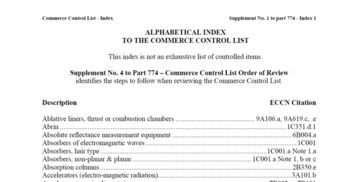
The EAR includes a critical introductory section to the CCL called the "Order of Review" (EAR § 738.2, Supplement No. 1 to Part 774 - Introduction). This section provides a logical flowchart and instructions on how to systematically determine if an item is classified under an ECCN. For market research, reviewing this order helps understand the classification logic.
Additionally, the CCL has a "Index" at the end of Supplement No. 1. You can look up common product names alphabetically to find potential ECCN references.
Method C: Using the BIS "Commerce Control List (CCL) to Schedule B Cross-Reference" Tool
For market researchers more familiar with harmonized tariff codes, BIS provides a useful cross-reference tool.
- On the BIS website, search for "CCL to Schedule B Cross-Reference."
- You can input a 10-digit Schedule B number (U.S. export code) to see if it is associated with one or more ECCNs. This is highly efficient if you know the product's tariff code.
Method D: Consulting the "Commerce Country Chart" and Understanding Reasons for Control
An ECCN is only half the story. Each ECCN entry lists specific Reasons for Control (e.g., NS - National Security, MT - Missile Technology, AT - Anti-Terrorism). These reasons must be cross-referenced with the Commerce Country Chart (EAR Part 738, Supplement No. 1) to determine if a license is required for a specific destination. Market research into a product's global marketability must factor in these potential license requirements.
4. Important Notes for Market Researchers
- Self-Classification is Complex: This guide is for preliminary research and awareness. Official ECCN classification for export compliance often requires detailed technical analysis and may necessitate a formal Classification Request (CCATS) submitted to BIS.
- EAR99 is a Key Designation: If, after review, your item is not listed on the CCL, it is designated as EAR99. EAR99 items are subject to the EAR but generally require a license only under specific circumstances (e.g., embargoed destinations, end-use/end-user concerns). Do not assume "no ECCN" means "no controls."
- Dynamic List: The CCL is updated periodically. Always verify the classification against the latest official version.
- Seek Expert Advice: For critical business decisions, investment analysis, or product development planning involving sensitive technologies, consulting with an export control attorney or compliance professional is strongly recommended.
By systematically using these official English resources, market researchers can gain valuable insights into the regulatory landscape surrounding their products of interest, identify potential trade barriers early, and make more informed strategic decisions.
如若转载,请注明出处:http://www.iviof.com/product/56.html
更新时间:2026-10-13 09:35:54